Gustav III was indisputably one of the greatest sovereigns of the
18th century. Unfortunately his genius never had full scope, and his opportunity came too late. Gustavus was, moreover, a most distinguished author. He may be said to have created the Swedish theatre, and some of the best acting dramas in the literature are by his hand. His historical essays, notably the famous anonymous eulogy on
Lennart Torstenson crowned by the
Swedish Academy, are full of feeling and exquisite in style, his letters to his friends are delightful. Every branch of literature and art interested him, every poet and artist of his day found in him a most liberal and sympathetic protector.
He fell a victim to a widespread aristocratic
conspiracy.
Shot in the back by
Jacob Johan Anckarström at a midnight
masquerade at the
Royal Swedish Opera in Stockholm, on
March 16,
1792.
The assassination of Gustav III, with the specifics changed by censorship, became the basis of
Giuseppe Verdi's
1859 opera
Un Ballo in Maschera (from
www.reference.com).
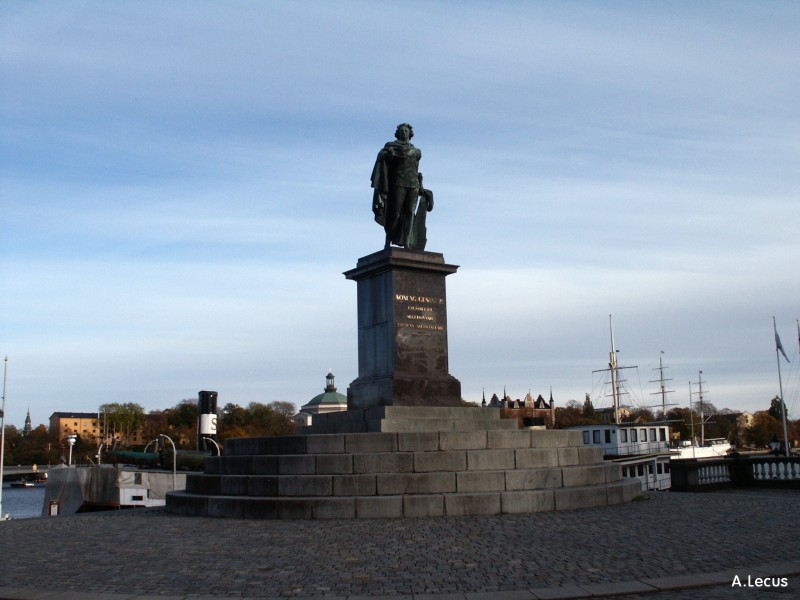
The image above represents
the place where
Gustav III statue used to be.
SERGEL, Johan Tobias (b. 1740, Stockholm, d. 1814, Stockholm) was commissioned by the city of Stockholm to make a monument for King Gustavus III of Sweden. Sergel presented the first sketch in 1790, and one year later a proportional model in plaster. After the full-scale, no longer extant model was completed in 1793, it took six more years for the bronze to be cast, the unveiling taking place only in 1808. In designing his portrait statue, Sergel was inspired by one of the most famous of classical statues, the Apollo Belvedere, but the figure of Gustavus, which is in imaginary ancient military dress that echoes contemporary clothing as well, is the wrong way round compared with the distinguished model. The free leg of the model becomes the engaged leg, while the drapery over the right arm of the king corresponds to the cloth around the outstretched left arm of Apollo. Finally, the taut physicality of the young, muscular archer of Antiquity becomes a rather slack pose of a ruler in the transition between the late Baroque and Neoclassicism.


 Gustav III was indisputably one of the greatest sovereigns of the 18th century. Unfortunately his genius never had full scope, and his opportunity came too late. Gustavus was, moreover, a most distinguished author. He may be said to have created the Swedish theatre, and some of the best acting dramas in the literature are by his hand. His historical essays, notably the famous anonymous eulogy on Lennart Torstenson crowned by the Swedish Academy, are full of feeling and exquisite in style, his letters to his friends are delightful. Every branch of literature and art interested him, every poet and artist of his day found in him a most liberal and sympathetic protector.